Search This Blog

Thursday, July 23, 2026

The Sewing Machine That Stitched a Dream


"Mom... why are you still keeping this old sewing machine? Why not throw it away?"

Akhil asked his mother as she was wiping the dust off the old sewing machine.

She remained silent for a moment.

Then she gently ran her hand over the machine and said,

"My son, this isn't just a sewing machine... it's the machine that stitched our lives back together."

Akhil didn't understand.

His mother continued,

"When your father abandoned us, you were only two years old. We didn't even have a single rupee at home. Our relatives comforted us during the first few days, but as time passed, everyone returned to their own lives."

"At that time, the only thing I had was this sewing machine."

"I worked in people's houses during the day... and stitched clothes on this machine all night."

Not even a single day did I get proper sleep.

I would sew until three in the morning.

Then I'd wake up at five and go back to work.

My hands were covered with cuts.

The sewing needle pierced my fingers countless times.

Even when they bled, I'd wrap them with a piece of cloth and continue sewing.

Because...

I couldn't bear to let you go hungry.

I had to educate you.

I wanted us to have a better life one day.

Akhil's eyes filled with tears.

He had never known any of this.

"I had only one determination—to prove myself to the man who abandoned us. I was never willing to accept defeat. I don't even like to remember the one who smiled, deceived us, and walked away."

His mother smiled and continued,

"Do you remember when you were in the fifth grade? The day everyone at school paid for the class tour, and you came home crying?"

"Yes, Mom."

"That day, I didn't have any money."

"So I stayed awake all night and stitched twelve blouses. The wages I received the next morning were what I used to pay for your tour fee."

Akhil lowered his head.

"Your Plus Two examination fee..."

"Your college admission..."

"Your hostel fee..."

"Your first laptop..."

"All of it was bought with the money this sewing machine earned."

His mother's voice trembled.

"The day you became an engineer and got your first job, I sat in front of this sewing machine and cried for a long time..."

"They were tears of joy..."

Because the God who stood by us wasn't our relatives or our neighbors...

It was this sewing machine. Everything we have came from it.

Years passed.

Akhil rose to a senior position in a reputed company.

He bought a beautiful house in the city and brought his mother to live with him.

Later, Akhil got married.

One day, while cleaning the house, his wife noticed the old sewing machine again.

She said,

"If we throw this away, we'll have a lot more space here."

Akhil immediately replied,

"No one should touch this machine."

His mother looked at him in surprise.

Akhil carefully cleaned the sewing machine and placed it beautifully in the living room.

His wife asked in amazement,

"Why are you keeping such an old sewing machine here?"

Akhil smiled and said,

"If it weren't for this sewing machine, I wouldn't be living in this house today."

His mother's eyes filled with tears.

One day, she peacefully bid farewell to the world.

On the anniversary of her passing, Akhil did something special.

He distributed sewing machines free of cost to poor widows.

Every time he handed over a machine, he would say,

"This is not just a sewing machine... it is a hope that can change the future of an entire family."

That day, Akhil finally understood...

His mother's hands had never merely stitched pieces of cloth.

They had stitched together her son's dreams, his future, and his entire life.


Monday, February 23, 2026

When Love Refuses to Sign the Final Page

 After the divorce, the husband stepped out of the court and quietly got into an auto-rickshaw.

His now-divorced wife, Seema, stepped into the same auto.

He looked at Seema—the woman who had shared ten years of his life—with deep sadness.
With a gentle smile, she said, “I felt my last ride to the bus station should be with you.”

He spoke softly, “In two or three months, I’ll arrange your alimony. I may have to sell the house… I built it for you. Without you there, what meaning does that house have for me?”

Seema quickly responded, “Please don’t sell the house. I don’t need any money. I’ve found a private job now. I can take care of our son and myself.”

Suddenly, the driver hit the brakes.
Seema lurched forward and was about to hit her head on the metal bar, but he instinctively grabbed her arms and pulled her back to safety.

With tears welling up, she whispered, “We may be separated… but you still haven’t stopped caring for me.” 😢

Silence settled between them.

After a moment, she asked softly, “It’s been two years… did you ever miss me?”

He replied, trying to sound firm, “What’s the use of talking about that now? It’s all over… we’re divorced.” 🥀

Seema swallowed hard and said, “In these two years, our daughter hasn’t visited you even once. Every night, she still talks about how she used to fall asleep with her head resting on your arm, as if it were her favorite pillow. She misses you… more than she says.” 😭

The auto reached the bus station.
They both stepped out.

He held her hands.
After such a long time, that simple touch made her eyes fill again.

Gently, he said, “Come… let’s go home.”

Seema froze.
“What about the divorce papers?”

With a faint smile, he said, “I’ll tear them up.”

The moment she heard those words, she broke down and embraced him tightly.
The relatives standing nearby quietly boarded the bus and left.

**********************

Do not hand over your relationships to relatives.
Talk to each other. Make your own decisions.

In relationships, don’t try to win.
Learn to lose for each other—that’s where love truly wins.

Most relationships don’t break because of problems.
They break because conversations stop.

Start talking to each other.
There is no complaint in this world that cannot be resolved through honest communication

Monday, November 10, 2025

“Why Did You Give Birth to Me?” — A Moment That Changed Amitabh Bachchan Forever


Exasperated by the mounting pressures of life, Amitabh Bachchan once found himself unable to contain his emotions — and questioned the very reason for his existence.

“Angered, frustrated, and overwhelmed by unreasonable thoughts, I walked into my father’s study one evening,” Amitabh recalled. “For the first time in my life, with a choked voice and tears in my eyes, I raised my voice at him and screamed, ‘Why did you give birth to me? Aapne humein paida kyun kiya?’

His father, the legendary poet Harivansh Rai Bachchan, was deeply engrossed in his writing, as always. Startled at first, he soon composed himself and looked at his son with calm understanding. The two sat in silence — neither speaking, neither moving. “Not a sound,” Amitabh remembered. “The night that followed was uncomfortable and heavy.”

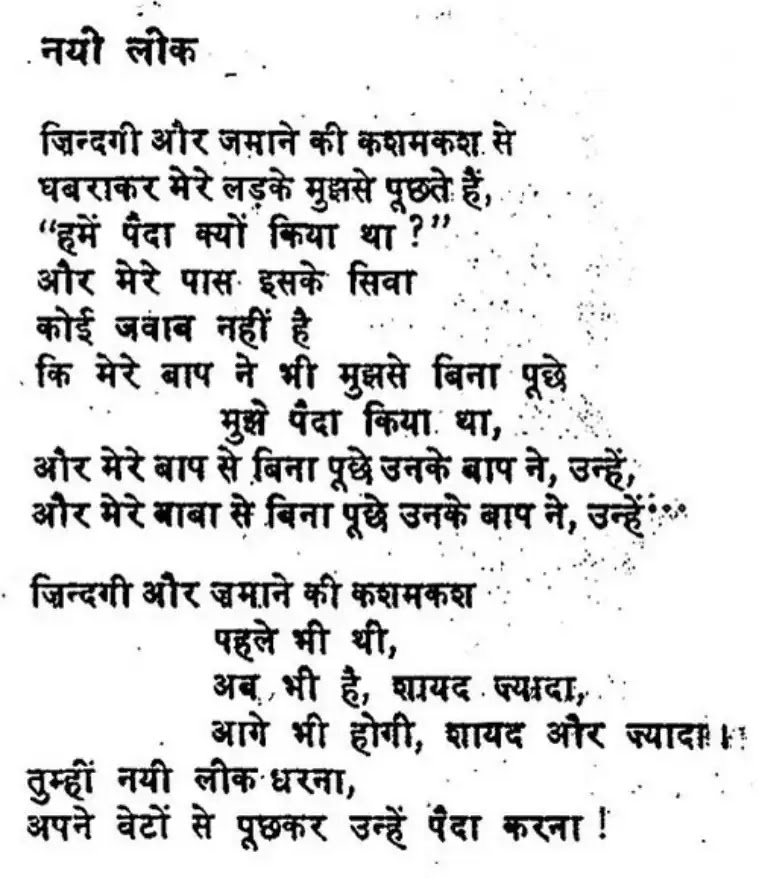
The next morning, Harivansh Rai quietly walked up to his son and handed him a folded piece of paper. On it was a poem titled “Nayi Leek” (A New Path) — his poetic response to the question that had shaken the silence the night before.


In the poem, the father wrote that his son had asked why he was brought into this world, burdened as he was by the problems and tensions of life — a question for which the father had no answer. His own father had never asked him before giving him life, nor had his grandfather asked his father, nor his great-grandfather before that.
Why not begin anew?” the poem urged. “The struggles and pressures of life have only grown and will continue to increase in the days to come. So, create a new way of thinking — ask your sons before bringing them into this world.

Reflecting on his father’s profound response, Amitabh later wrote on his blog, encouraging readers to take ownership of their lives:

“There are no excuses in life and no one to blame. Every morning brings a new challenge. Either you pick up the gauntlet and fight, or you surrender to it. So long as there is life, there is struggle.”

Harivansh Rai Bachchan passed away in 2003 at the age of 95, but his wisdom continues to guide generations — reminding us that life, no matter how difficult, is a journey meant to be faced with courage and reflection.

Tuesday, November 4, 2025

The Two Rupees


After lunch, when the teacher returned to class, I noticed a small sheet of paper in her hand.

It was stamps. She tore it carefully into pieces, handing one to each of us.
“Tomorrow,” she said, “everyone must bring two rupees.”

The whole class nodded in agreement, and I, without thinking, nodded too.
I slipped the stamp into my notebook and thought nothing more of it.

On my way home from school, my mind wandered to the empty mustard jar and the little betel box on my mother’s shelf.
Why had I joined the others in nodding?
As I walked along the ridge beside the fields, I wondered if I should return the stamp the next morning and tell the teacher I didn’t want it.
But what if she got upset? What if she scolded me in front of everyone? I didn’t know.

After crossing the field and the narrow bridge made of banana trunks, I reached home.
Mother was in the courtyard, gathering and tying the fallen snake-gourd vines she had been tending with care.
Grandmother had just come back from the garden, peeling the husks off freshly picked areca nuts.

“Is Kannan home?” Mother asked, taking my schoolbag from my shoulder and placing it on the verandah ledge.
“Shall I make you some tea?” she added, walking into the kitchen.

I sat quietly on the verandah. The wind from the fields blew cool and soft, but deep inside, I felt a faint, heavy warmth.
When Mother brought the tea, it tasted less sweet than usual.
I didn’t ask her why.

Later, when Mother handed me the grocery bag and asked me to buy a few items, I went to Ramu, the grocer.
He looked at me and said bluntly,
“Settle what you owe first — only then can you buy the next lot. If everyone starts doing this, I might as well shut down the shop.”

A faint laugh escaped from a few people standing nearby — someone trying to hide their amusement.
I didn’t look to see who it was.
To keep my tears from falling, I turned and ran home.

Mother was still standing on the verandah.
When she saw the empty grocery bag in my hand, she didn’t say a word.
Something flickered across her face and disappeared before I could name it.
As she wiped her eyes and went inside, she glanced for a moment at Father’s photograph hanging on the wall.
I thought — if only he were here, perhaps all this sadness would vanish.

The next morning, I woke with a strange heaviness.
I didn’t feel like going to school.
Would my classmates whisper or laugh behind my back, like Ramu at the shop?
But how could I stay home with no reason?
And I couldn’t lie to Mother either.

Before leaving, I looked into the kitchen — at the mustard jar —
hoping to find, maybe, a stray two-rupee coin hidden somewhere,
something that could save a fourth-grader’s pride.
But there wasn’t even a mustard seed left inside.

When the school bell rang, my chest tightened.
After attendance, the teacher said,
“Now, one by one, bring your money for the stamp.”

I looked around — my face was the only one pale and tense.
“What’s wrong, Kannan? Didn’t do your homework?” she asked.
“Yes… I did,” I whispered.

She said nothing more. The next boy went up and placed his two rupees neatly on the desk.
Then it was Sreekuttan’s turn.

By the time I stood up slowly, the teacher said,
“Sreekuttan’s mother gave his money yesterday.”

I froze. I hadn’t told my mother anything —
then how could she have given it?

After school, I ran home and asked,
“Amma, did you see Rajalakshmi teacher yesterday?”
“No, I didn’t go anywhere,” she said.
“Really, you didn’t?”
“No, dear. Why, what happened? Did you do something wrong?”
“No, nothing…”

The next day, I went straight to the teacher.
“If my mother didn’t give it, then how did you get the two rupees?” I asked.

She brushed the hair from my forehead and smiled softly.
“Teachers are mothers too,” she said.
“And remember, you should never have to run past Ramu’s shop with tears in your eyes.
Whatever you need, just tell your teacher.”

I didn’t even realize that tears were streaming down again —
but this time, they were tears of hope.

Among the half-hidden giggles at Ramu’s shop,
I found someone who knew how to love.
A teacher who protected a fourth-grader’s pride —
not just like a mother,
but truly, a mother herself.

Wednesday, December 6, 2023

Beyond the Suit: Billy Graham's Profound Reflection on Identity and Destination


At the age of 92, Billy Graham, grappling with Parkinson's disease, faced a dilemma when invited to a luncheon in his honor a month before his 93rd birthday in Charlotte, North Carolina. Initially hesitant due to his health challenges, the Charlotte leaders reassured him, expressing a desire to honor him without expecting a major address. Encouraged, Billy agreed to attend.


After wonderful things were said about him, Dr. Graham stepped to the podium, looked at the crowd, and said:


"I'm reminded today of Albert Einstein, the great physicist who this month has been honored by Time magazine as the Man of the Century. Einstein was once traveling from Princeton on a train, when the conductor came down the aisle, punching the tickets of every passenger. When he came to Einstein, Einstein reached in his vest pocket. He couldn't find his ticket, so he reached in his trouser pockets. It wasn't there.He looked in his briefcase but couldn't find it. Then he looked in the seat beside him. He still couldn't find it.


"The conductor said, “Dr. Einstein, I know who you are. We all know who you are. I'm sure you bought a ticket. Don't worry about it.”  Einstein nodded appreciatively. The conductor continued down the aisle punching tickets. As he was ready to move to the next car,he turned around and saw the great physicist down on his hands and knees looking under his seat for his ticket.


"The conductor rushed back and said, 'Dr. Einstein, Dr. Einstein, don't worry, I know who you are; no problem. You don't need a ticket.  I'm sure you bought one.'Einstein looked at him and said,  “Young man, I too, know who I am. What I don't know is where I'm going."


Having said that Billy Graham continued, "See the suit I'm wearing? It's a brand new suit. My children, and my grandchildren are telling me I've gotten a little slovenly in my old age. I used to be a bit more fastidious. So I went out and bought a new suit for this luncheon and one more occasion. You know what that occasion is? This is the suit in which I'll be buried. But when you hear I'm dead, I don't want you to immediately remember the suit I'm wearing. I want you to remember this:


"I not only know who I am. I also know where I'm going." May your troubles be less, your blessings more, and may nothing but happiness, come through your door. "Life without God is like an unsharpened pencil - it has no point."


May each of us have lived our lives so that when our ticket is punched we don't have to worry about where we are going

Friday, June 16, 2023

It is More Blessed to Give - Christmas Story


On the evening of Christmas Eve, George left his office and discovered a young boy admiring his brand-new car. Intrigued, the boy asked, "Is this your car, sir?" George nodded and replied, "Yes, my brother gave it to me as a Christmas present." The boy was taken aback and exclaimed, "Your brother gave you a car for free? The boy was surprised. "You mean your brother gave it to you and it didn't cost you anything? Boy, I wish..." He hesitated. George knew what he was going to wish for. He was going to wish he had a brother like the one George has. But what the lad said was far beyond Goerges' expectation. "I wish," the boy went on, "that I could be a brother like that."

For a few seconds words failed Reggie and then he impulsively added, "Would you like to take a ride in my automobile?"

Excitedly, the boy accepted the offer. After a short drive, the boy requested that George stop in front of his house. George assumed the boy wanted to show off the luxurious car to his neighbors. However, he was mistaken.

"Can you stop by those two steps?" the boy asked. He hurriedly went up the steps and returned, carrying his younger brother, who had physical challenges. Placing him on the bottom step, the boy snuggled up next to him and proudly pointed at the car. "Look, Buddy, just like I described earlier. His brother gave it to him for Christmas, and he didn't have to pay anything. Someday, I'll give you a car like this, and then you can see all the beautiful things in the Christmas windows that I've been telling you about."

George got out of the car and helped the boy settle his brother in the front seat. With joy gleaming in their eyes, the three embarked on a memorable holiday ride.

That Christmas Eve, George learned the profound meaning behind Jesus' words: "It is more blessed to give..."

Thursday, June 8, 2023

Insights of the Blind: Embracing Perspectives to Uncover Truth


Once upon a time, in a small village, there resided a group of blind men. They lived their lives without ever truly knowing what an elephant looked like or how it appeared to the sighted world. One day, a piece of exciting news spread among the villagers—the owner of the village had acquired an elephant. The blind men were intrigued by this fascinating creature they had only heard of through stories.

Eager to gain knowledge and understand this majestic animal, the blind men gathered together to discuss their plan. They agreed that in order to comprehend the elephant, they must rely on their sense of touch. They sought permission from the owner and were granted access to the magnificent beast.

As they approached the elephant, a wave of anticipation washed over them. One by one, they cautiously reached out, exploring the unknown with their hands. The first blind man, his hands grazing the sturdy leg of the elephant, confidently declared, "The elephant is like a pillar!"

The second blind man, feeling the swaying tail, had a different perspective. He argued, "No, my friends, the elephant is like a rope, flexible and slender."

The third blind man extended his hand, feeling the long, powerful trunk of the elephant. He declared, "You both are mistaken. The elephant is akin to a thick branch of a tree."

The fourth blind man, gently touching the large, flapping ear, expressed his own interpretation, "No, the elephant is more like a grand hand fan, capable of creating a gentle breeze."

Lastly, the fifth blind man, his hands exploring the vast belly of the elephant, insisted, "None of you truly understand. The elephant is like an enormous wall, solid and impenetrable."

As each blind man passionately shared their individual experiences, their differing descriptions sparked a heated debate. Confusion and disagreement filled the air, with each one firmly believing they held the truth about the elephant's nature. It seemed impossible to reconcile their conflicting views.

Observing the commotion, a wise old man approached the group. His eyes may have been dim, but his insight was profound. He gathered the attention of the blind men and spoke in a calm, soothing voice.

"All of you," he began, "are both right and wrong. The reason for your differing descriptions is simple. Each one of you touched a different part of the elephant. So, in reality, the elephant possesses all those features that you have described."

As the wise old man's words sank in, understanding slowly illuminated their minds. The blind men realized that their limited perspectives prevented them from comprehending the complete truth. Their individual experiences merely provided glimpses of the whole, but none of them had grasped the entirety of the elephant's magnificent presence.

The moral of this story is that truth can be subjective and dependent on one's limited perspective. Just like the blind men, we often form incomplete judgments based on our individual experiences and perceptions. It is only by embracing diverse viewpoints and combining them that we can gain a more comprehensive understanding of the world around us.

This story teaches us the importance of open-mindedness, empathy, and collaboration. It encourages us to recognize that different people may have different perspectives and interpretations based on their unique experiences. By actively listening and seeking to understand each other's viewpoints, we can broaden our horizons and cultivate a more inclusive and harmonious society.